
Should AI-generated summaries be shown to customers?
They can be confirmed with the customer when useful, but staff-facing summaries should remain labelled and traceable to the original conversation.
AI
Define the summary, evidence, customer context, consent, ownership, and status an AI support workflow must pass to a person.

How the workflow connects
A transfer button does not create a useful escalation. The support system needs a handoff record that separates customer statements, retrieved source material, generated summaries, attempted actions, and unresolved questions. That structure helps staff verify context before responding.
List conditions such as explicit customer request, low confidence, missing approved knowledge, account-specific changes, payment or safety concerns, repeated misunderstanding, and system failure. Each condition can map to a queue, priority, response target, and permitted interim message.
Store the customer's messages, timestamps, channel, verified account context, retrieved knowledge references, generated summary, and actions attempted. Label generated fields so staff do not mistake a model inference for a customer statement or confirmed system fact.
Create an assigned record with new, queued, accepted, waiting, resolved, and reopened states. Tell the customer that a person will review the request and provide a realistic response channel or timeframe. Do not claim the transfer is complete until the support system has accepted it.
Let staff mark incorrect retrieval, missing knowledge, unsafe action proposals, and routing errors. Review those labels to improve sources, rules, and evaluations. Preserve the original interaction so quality reviews are based on evidence rather than the corrected final answer alone.
A customer asks why a payment appears twice and wants one charge reversed. The assistant can identify the account only through the approved identity flow, collect the invoice references, and provide general billing guidance from an approved source. It should not claim that a refund occurred or infer which charge is valid.
The handoff record preserves the customer's wording, verified identifiers, relevant messages, sources already shown, and the unresolved request. A billing queue receives the record with a clear reason and priority. The customer receives an acknowledgement that explains the next channel and expected response window, while the automated workflow stops any consequential billing action.
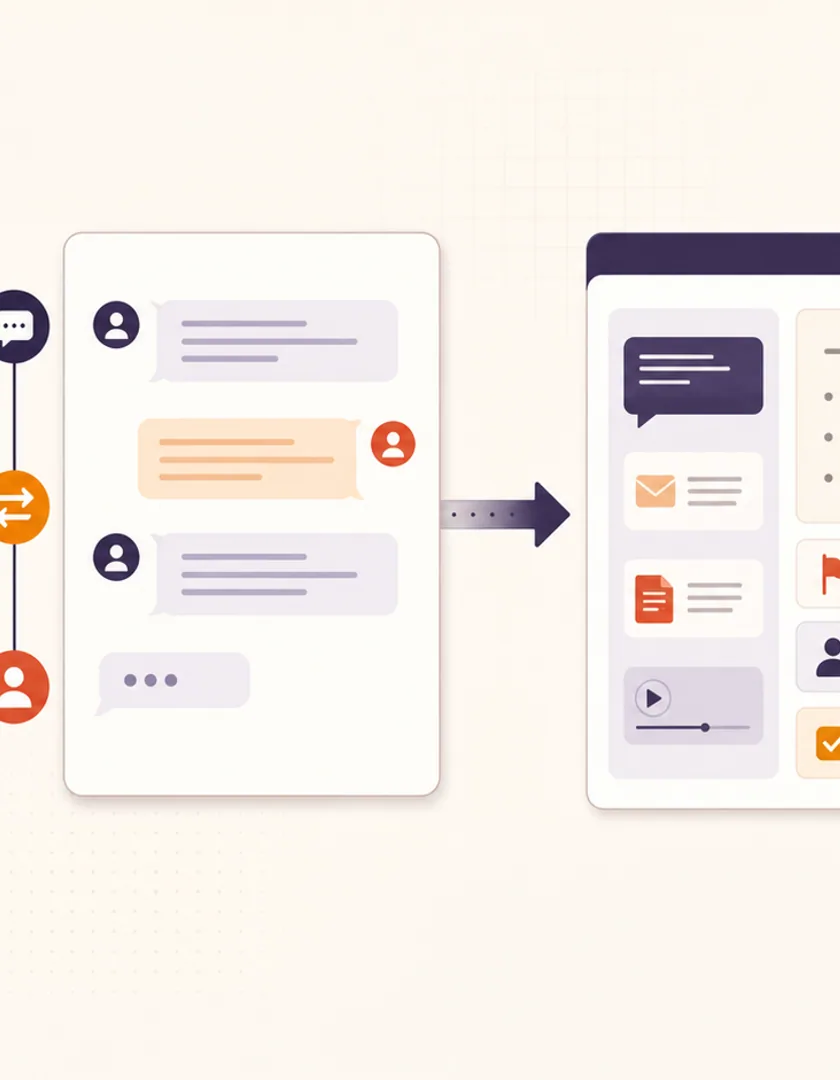
Visual guide
The transfer carries evidence and ownership forward instead of reducing the conversation to an unverified summary.
Handoff condition
Detect explicit request, low confidence, restricted action, or repeated misunderstanding.
Evidence record
Preserve customer statements, timestamps, channel, and verified identifiers.
Generated context
Label summary, intent, and proposed next action as generated fields.
Queue and owner
Apply business routing, priority, response target, and acceptance state.
Human continuation
Let staff verify context, respond, and record the resolution.
Keep the handoff record no broader than the support task requires. Authentication state, consent, retention, and staff permissions should travel with the record where relevant. Mask secrets and payment data, and prevent generated summaries from copying sensitive material into channels with wider access.
Evaluation should use realistic conversations: missing account context, conflicting customer statements, urgent language without an urgent issue, unavailable downstream systems, and a customer returning after the first handoff. Measure whether the correct cases escalate, whether agents receive enough evidence, how often routing is corrected, and whether customers repeat information—not whether the assistant avoided human involvement at all costs.

Practical questions
They can be confirmed with the customer when useful, but staff-facing summaries should remain labelled and traceable to the original conversation.
It may provide a bounded acknowledgement or collect approved details. It should not continue the disputed or consequential action unless the workflow explicitly permits it.
Continue exploring
Work with Sun Cluster
Sun Cluster builds AI-assisted support workflows with controlled knowledge, human escalation, connected records, and operational review.